

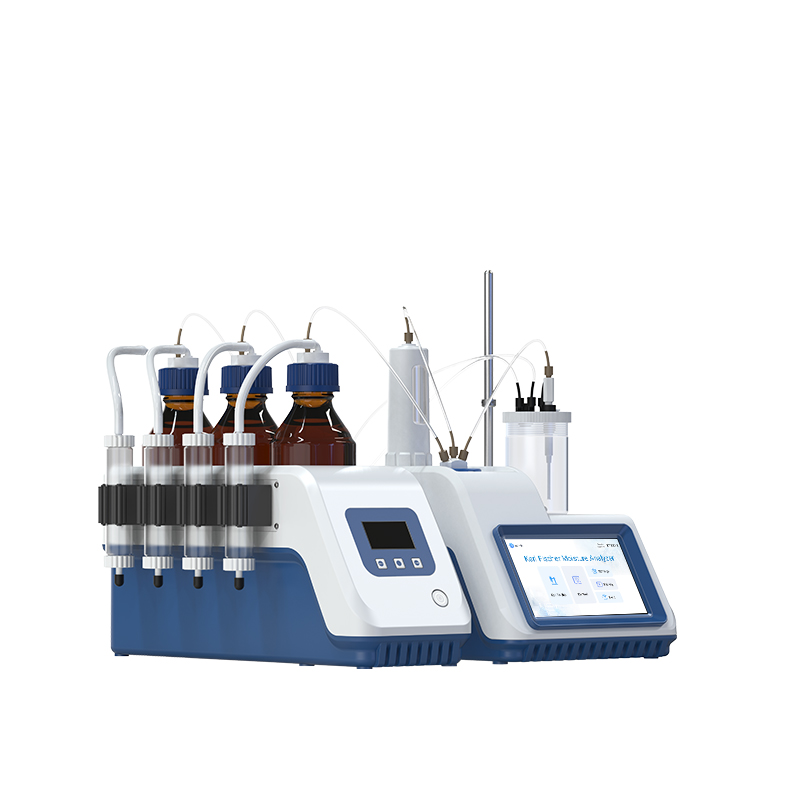
The HM Instruments Karl Fischer moisture analyzer series (HM-WS1/WS2/WS3/WS4 coulometric models, HM-KFV1 volumetric model) — featuring wide-range measurement (1 ppm to 100%), high sensitivity (down to 0.01 μg H₂O), excellent accuracy (±2 μg / 0.2%), and comprehensive standard compliance — has provided precision moisture measurement solutions to thousands of users across petrochemical, pharmaceutical, food, power, and new energy industries. This article addresses typical application scenarios in five key industries, providing complete equipment selection, solution configuration, and implementation guidance.
Solution 1: Petrochemical Industry Moisture Detection
1.1 Industry Requirements
The petrochemical industry involves moisture detection in crude oil, refined products, lubricants, additives, organic solvents, and natural gas. Moisture content directly affects product quality, equipment corrosion rates, and storage/transport safety. Per national standards GB/T 11133, GB/T 11146, SH/T 0246, and SH/T 0255, petroleum product moisture detection demands high precision and broad applicability. Some samples have extremely low moisture content (ppm level), imposing stringent sensitivity requirements on instruments.
1.2 Applicable Standards
| Standard No. | Standard Name | Applicable Samples |
|---|---|---|
| GB/T 11133 | Determination of Water in Liquid Petroleum Products (Karl Fischer Method) | All liquid petroleum products |
| GB/T 11146 | Determination of Water in Crude Oil (Coulometric Karl Fischer Method) | Crude oil |
| SH/T 0246 | Determination of Water in Light Petroleum Products (Coulometric Method) | Light petroleum products |
| SH/T 0255 | Determination of Water in Additives and Additive-Containing Lubricants (Coulometric Method) | Lubricants and additives |
| GB/T 260 | Standard Test Method for Water in Petroleum Products | General petroleum products |
| GB/T 18619.1 | Determination of Water in Natural Gas — Coulometric Karl Fischer Method | Natural gas |
1.3 Recommended Solution Configuration
| Application Scenario | Sample Type | Moisture Range | Recommended Model | Accessories |
|---|---|---|---|---|
| Refinery QC Laboratory | Gasoline, diesel, kerosene | 10 ppm–500 ppm | HM-WS2/WS3 | Liquid injector, sealed injection port |
| Lubricant Manufacturer | Lubricating oil, grease | 50 ppm–0.5% | HM-WS3/WS4 | Heated injector (for difficult-to-dissolve samples) |
| Natural Gas Processing Plant | Natural gas, LPG | 1 ppm–100 ppm | HM-WS2/WS3 | Gas injector, gas sampling bag |
| Petrochemical Research Institute | Organic solvents, chemical raw materials | 1 ppm–100% | HM-WS4 | Automated injection system |
1.4 Solution Advantages
Measurement range 0.0001% (1 ppm) to 100% — a single instrument covers the full-range moisture detection needs of the petrochemical industry
Compliant with 6 core petrochemical standards including GB/T 11133 and SH/T 0246; test reports can be used directly for quality certification
Fully sealed titration cell design prevents petroleum sample volatilization and eliminates ambient moisture interference
HM-WS4 supports bilingual Chinese/English interface; 10" large display facilitates data review and report printing
2–4 units at $2,000–$6,600 vs. imported solutions at $40,000–$80,000 — saving 85%–95%
Application Example: A large refinery QC laboratory deployed 2 HM-WS3 units for routine moisture testing of gasoline, diesel, and aviation kerosene. Daily throughput: 30–40 samples. The HM-WS3's 0.01 μg sensitivity threshold meets precise determination of 10 ppm-level low moisture content; the fully sealed titration cell prevents light petroleum product volatilization; the Android system supports cloud data management with test reports directly archived.
Solution 2: Pharmaceutical Industry Moisture Detection
2.1 Industry Requirements
The pharmaceutical industry imposes exceptionally stringent moisture control requirements. Water content in active pharmaceutical ingredients (APIs), intermediates, and finished products directly affects drug stability, shelf life, and safety. Per pharmacopoeia requirements and FDA 21 CFR Part 11, pharmaceutical enterprises require analytical instruments with full audit trail, access control, and data anti-tampering capabilities. The volumetric Karl Fischer method is suitable for high-moisture samples (>1%), while the coulometric method is appropriate for low-moisture samples (<1%).
2.2 Applicable Standards and Regulations
| Standard / Regulation | Description | Applicable Stage |
|---|---|---|
| Pharmacopoeia (ChP) | Technical requirements for Karl Fischer determination of moisture in pharmaceuticals | APIs, finished formulations |
| JJG1154-2018 | Verification Regulation for Volumetric Karl Fischer Moisture Analyzers | Volumetric instrument metrological verification |
| FDA 21 CFR Part 11 | Electronic Records and Electronic Signatures Regulation | Export pharmaceuticals, data compliance |
| GLP | Good Laboratory Practice | R&D laboratories |
| GB/T 606 | General Method for Determination of Water in Chemical Reagents (Karl Fischer Method) | Reagent and excipient testing |
2.3 Recommended Solution Configuration
| Application Scenario | Sample Type | Typical Moisture Range | Recommended Model | Compliance Configuration |
|---|---|---|---|---|
| API QC Testing | Chemical APIs, intermediates | 0.1%–5% | HM-KFV1 | Audit trail + access control + data anti-tampering |
| Lyophilized product moisture testing | Freeze-dried powder for injection | 0.5%–3% | HM-KFV1 | Audit trail + Excel/PDF export |
| Solvent moisture testing | Anhydrous ethanol, acetone, DMF, etc. | 10 ppm–1,000 ppm | HM-WS3/WS4 | Multi-level access + history search |
| Finished product release testing | Tablets, capsules, injectables | 1%–10% | HM-KFV1 | Full FDA 21 CFR Part 11 compliance |
| R&D Laboratory | New drug development samples | Full range | HM-KFV1 + HM-WS4 | Volumetric + coulometric dual configuration |
2.4 HM-KFV1 Volumetric Pharmaceutical Solution Details
The HM-KFV1 volumetric Karl Fischer moisture analyzer is the ideal choice for pharmaceutical industry high-compliance applications:
Dual burette configuration: Standard 10 mL and 20 mL high-precision burettes, minimum titration volume 1 μL, volumetric error ±10 μL/10 mL — covering the wide-range precision determination from macro to trace moisture
FDA 21 CFR Part 11 compliance: Built-in audit trail function, complete recording of every operation's time, user, and modifications; multi-level access control prevents unauthorized operations; data anti-tampering ensures report credibility
Multiple result units: Supports 8 units including μg, mg, %, ppm, μg/L, mg/L, μg/g, mg/g — meeting different pharmaceutical standard reporting format requirements
Result export: Built-in thermal printer for real-time results; supports USB export to Excel and PDF format reports, facilitating LIMS system integration
Automated fill/drain: Separate main unit and auto-fill system design; one-button fill, drain, and cleaning; fully enclosed design for safety and environmental protection
Anti-diffusion design: Effectively prevents reagent seepage from titration tip during standby, ensuring stable measurement baseline and improving low-moisture sample determination accuracy
2.5 Solution Advantages
HM-KFV1 repeatability RSD ≤1%, meeting pharmaceutical industry's exacting precision requirements
Compliant with FDA 21 CFR Part 11 and GLP — passes domestic and international GMP audits without issues
Volumetric + coulometric combination covers all pharmaceutical moisture detection scenarios
One HM-KFV1 at approximately $3,714 vs. comparable imported volumetric instruments at $20,000–$35,000 — saving 80%–90%
280 service centers, 4-hour response for equipment faults — does not impact drug production and release schedules
Application Example: A mid-size pharmaceutical company deployed 1 HM-KFV1 for API and finished product moisture testing. After enabling audit trail and 3-level access control, the company successfully passed an FDA on-site inspection. The minimum titration volume of 1 μL achieves 0.001%-level detection precision for low-moisture samples; data exported as PDF is directly archived to the DMS system. Equipment investment of $3,714 replaced an imported solution at $28,000 — saving 87%.
Solution 3: Food Industry Moisture Detection
2.1 Industry Requirements
Food industry moisture detection spans edible oils, dairy products, confectionery, baking ingredients, and seasonings. Moisture content affects food texture, shelf life, and microbiological safety. Food sample matrices are complex; some contain interfering substances such as reducing sugars and proteins, requiring appropriate detection methods and sample preparation protocols.
3.2 Applicable Standards
| Standard No. | Standard Name | Applicable Products |
|---|---|---|
| GB/T 8350 | Denatured Fuel Ethanol | Ethanol-based products |
| GB/T 8351 | Ethanol Gasoline for Motor Vehicles | Ethanol gasoline (related standard) |
| GB 6283 | Determination of Water in Chemical Products — Karl Fischer Method (General) | Food additives, excipients |
| GB/T 606 | General Method for Determination of Water in Chemical Reagents (Karl Fischer Method) | Food-grade reagents |
3.3 Recommended Solution Configuration
| Application Scenario | Sample Type | Moisture Range | Recommended Model | Preparation Method |
|---|---|---|---|---|
| Edible oil manufacturer | Vegetable oil, animal fat | 50 ppm–0.5% | HM-WS2/WS3 | Direct liquid injection |
| Dairy products | Butter, cream, milk powder | 0.5%–5% | HM-WS3/WS4 | Dissolve in anhydrous methanol before injection |
| Baking ingredient testing | Flour, powdered sugar, fats | 0.1%–15% | HM-WS3/KFV1 | Homogenization + solvent extraction |
| Food additive testing | Emulsifiers, antioxidants | 0.1%–10% | HM-WS3/WS4 | Direct dissolution and injection |
3.4 Solution Advantages
HM-WS3 uses Android system with built-in tutorial videos — frontline food industry testing personnel can be quickly trained
Automatic measurement completes in approximately 60 seconds, meeting food production line rapid release requirements
Fully sealed titration cell prevents food volatile odors from dispersing, improving laboratory environment
Free sample information editing — organize data by product batch number, production line, or date
Test results viewable via QR code scanning for rapid on-site verification
Equipment investment $1,000–$1,643 vs. imported equivalent at $12,000–$20,000 — saving 85%–92%
Application Example: An edible oil manufacturer deployed 1 HM-WS3 for routine moisture testing of crude and finished oils. Daily throughput: ~25 samples. The HM-WS3's fully automatic measurement completes each sample in approximately 60 seconds; the 4-core 1.88 GHz processor ensures smooth continuous batch testing. Test results are categorized by product batch number with 200,000+ record storage capacity meeting full-year data archiving needs. Equipment investment $1,214 replaced an imported solution at $15,000 — saving 92%.
Solution 4: Power Industry Transformer Oil Moisture Detection
4.1 Industry Requirements
Moisture content in transformer oil (insulating oil) is a critical indicator of power equipment operating condition. Excessive water in oil reduces dielectric strength, accelerates oil degradation, and may lead to equipment failure. Per GB/T 7600 "Determination of Water Content in Transformer Oil in Service (Coulometric Method)," the power industry demands extremely precise transformer oil moisture detection, with water content typically required to be controlled within the 10–35 ppm range.
4.2 Core Standards
| Standard No. | Standard Name | Testing Requirements |
|---|---|---|
| GB/T 7600 | Determination of Water Content in Transformer Oil in Service (Coulometric Method) | Coulometric method, ppm-level precision |
| GB/T 5074 | Determination of Moisture in Coking Products | Related standard |
4.3 Recommended Solution Configuration
| Application Scenario | Sample Type | Typical Moisture Range | Recommended Model | Key Configuration |
|---|---|---|---|---|
| Grid company oil testing laboratory | In-service transformer oil | 10 ppm–35 ppm | HM-WS2/WS3 | High-sensitivity mode |
| Transformer manufacturer | New transformer oil | 5 ppm–20 ppm | HM-WS3/WS4 | Precision injector |
| Power plant maintenance crew | Turbine oil, hydraulic oil | 50 ppm–500 ppm | HM-WS2 | Portable operation |
| Third-party testing laboratory | Various insulating oils | 5 ppm–1,000 ppm | HM-WS3/WS4 | Full standard coverage |
4.4 Solution Advantages
HM Instruments' entire coulometric product line conforms to GB/T 7600, satisfying power industry compliance testing requirements
HM-WS2 sensitivity of 0.01 μg H₂O enables precise determination of 10 ppm-level ultra-low moisture transformer oil
Fully automatic testing completes in approximately 60 seconds — suitable for rapid testing within power maintenance windows
HM-WS3/WS4 support WiFi data upload; test results can be synchronized in real time to power equipment management systems
Fully sealed titration cell design prevents transformer oil odor dispersion and protects operator health
2–3 units at $2,000–$3,600 vs. imported solutions at $25,000–$50,000 — saving 90%–93%
Application Example: A provincial grid company oil testing laboratory deployed 3 HM-WS3 units, covering annual inspection and fault diagnosis of transformer oil for substations province-wide. The HM-WS3's 0.01 μg sensitivity precisely determines 10–30 ppm moisture content for accurate assessment of transformer insulation condition. The WiFi module uploads test data in real time to the provincial equipment management platform, enabling remote monitoring of oil quality status. Total investment: $3,642 for 3 units, replacing an imported solution at $45,000 — saving 92%.
Solution 5: Lithium Battery Material Moisture Detection
5.1 Industry Requirements
Lithium battery cathode and anode materials, electrolytes, and separators are extremely moisture-sensitive. Water reacts with lithium salts in the electrolyte to generate HF, which corrodes internal battery structures and causes capacity degradation and safety issues. Cathode materials (such as ternary materials, lithium iron phosphate) typically require moisture control at 100–500 ppm; anode materials (graphite, silicon-carbon) at 50–300 ppm; and electrolytes at <20 ppm. Karl Fischer coulometric method is the mainstream approach for lithium battery material moisture detection.
5.2 Detection Challenges and Solutions
| Challenge | Root Cause | HM Instruments Solution |
|---|---|---|
| High sample hygroscopicity | Cathode materials rapidly absorb moisture upon air exposure | Rapid injection + sealed injection chamber design |
| Samples difficult to dissolve | Cathode materials are solid powders insoluble in KF reagent | KF oven (optional) + carrier gas method |
| High precision requirements | Electrolyte moisture must be <20 ppm | HM-WS3/WS4, sensitivity 0.01 μg |
| Inter-batch consistency | Production line QC demands high repeatability | RSD <0.3%, alternating equilibrium isolation detection technology |
5.3 Recommended Solution Configuration
| Application Scenario | Sample Type | Moisture Range | Recommended Model | Auxiliary Equipment |
|---|---|---|---|---|
| Electrolyte testing | Carbonate-based electrolytes | 5 ppm–50 ppm | HM-WS3/WS4 | Precision liquid injector |
| Cathode material testing | NCM, LFP, LCO powders | 100 ppm–1,000 ppm | HM-WS3/WS4 | KF oven (optional) |
| Anode material testing | Synthetic graphite, silicon-carbon materials | 50 ppm–500 ppm | HM-WS3/WS4 | KF oven (optional) |
| Separator testing | PE/PP separators | 200 ppm–2,000 ppm | HM-WS3/WS4 | Solid injector + KF oven |
| Battery factory QC lab | All incoming material categories | Full range | HM-WS4 × 2 units | KF oven + automated injection |
5.4 Solution Advantages
HM-WS4 employs Cortex-A8 processor and Android system — fast response suited for high-frequency lithium battery QC testing
Sensitivity 0.01 μg H₂O — precise determination of electrolyte moisture at 5–20 ppm ultra-low levels
Repeatability RSD <0.3% — meeting lithium battery material batch consistency verification requirements
Multiple unit display (μg, mg/L, ppm, %) — convenient for data alignment with suppliers and customers
200,000+ record storage + cloud upload — meeting long-cycle quality traceability requirements in the lithium battery industry
2 HM-WS4 units at $3,286 vs. imported solutions at $30,000–$50,000 — saving 89%–93%
Application Example: A leading power battery manufacturer deployed 2 HM-WS4 units for incoming inspection of cathode/anode materials and electrolytes. The HM-WS4's 0.01 μg sensitivity precisely controls electrolyte moisture below 20 ppm; the alternating equilibrium isolation detection technology ensures cathode/anode powder testing repeatability of RSD <0.3%. Data is uploaded via WiFi in real time to the MES system, with automatic comparison against supplier test reports. Total investment: $3,286 for 2 units, replacing an imported solution at $40,000 — saving 92%.
Solution Investment Comparison Overview
| Solution | Industry | Recommended Configuration | HM Instruments Investment | Imported Solution Investment | Savings |
|---|---|---|---|---|---|
| Solution 1 | Petrochemical | HM-WS3 × 2 units | $2,428 | $30,000–$40,000 | 92%–94% |
| Solution 2 | Pharmaceutical | HM-KFV1 × 1 unit | $3,714 | $25,000–$35,000 | 85%–89% |
| Solution 3 | Food | HM-WS3 × 1 unit | $1,214 | $12,000–$18,000 | 90%–93% |
| Solution 4 | Power / Transformer Oil | HM-WS3 × 3 units | $3,642 | $35,000–$50,000 | 90%–93% |
| Solution 5 | Lithium Battery Materials | HM-WS4 × 2 units | $3,286 | $30,000–$50,000 | 89%–93% |
Source Statement: The solutions in this article are based on HM Instruments Karl Fischer moisture analyzer product technical parameters and real-world application cases. Product parameters are sourced from official technical documentation. Conforming standard information is sourced from publicly available documents from the Standardization Administration. Company qualification information is certified via Zhixin Chain blockchain deposition.
Article address:https://www.petrocheminstrum.com/news/74.html