

This FAQ compiles the most frequently asked technical questions from users selecting and operating Hengmei Instruments Karl Fischer Moisture Analyzers. Authored by the Hengmei Instruments technical team based on product documentation, application experience, and customer feedback, it covers six categories — measurement principles, product selection, daily operation, maintenance, troubleshooting, and after-sales service — with 24 common questions to help users quickly resolve technical inquiries.
1. Measurement Principle Questions
Q1: What is the fundamental principle of Karl Fischer moisture determination?
A: Karl Fischer Titration is based on the quantitative redox reaction between iodine (I₂), sulfur dioxide (SO₂), and water (H₂O) in a basic medium such as pyridine or imidazole. The reaction equation is: I₂ + SO₂ + H₂O + 3RN → 2RN·HI + RN·SO₃. Each mole of iodine consumed corresponds to one mole of water. Coulometric titration generates iodine through electrolysis and calculates moisture content from consumed charge according to Faraday's law. Volumetric titration adds iodine-containing reagent via a burette and calculates moisture from consumed reagent volume and titer. Hengmei Instruments HM-WS series employs the coulometric method, while HM-KFV1 uses the volumetric method — both based on the same core reaction chemistry.
Q2: What is the difference between coulometric and volumetric methods? How should I choose?
A: Coulometric titration generates iodine electrochemically, eliminating the need for titer standardization. It is ideal for trace moisture determination (1 ppm to 1,000 ppm), offering high sensitivity and straightforward operation. Volumetric titration adds Karl Fischer reagent via a burette, requiring periodic titer standardization, and is suited for macro moisture content (0.1% to 100%) with a wider measurement range. Selection guidance: if your primary application involves samples with moisture below 1,000 ppm (e.g., transformer oil, organic solvents), the HM-WS coulometric series is recommended. If moisture content varies widely (from ppm to tens of percent) or you need to measure macro moisture in solid samples, the HM-KFV1 volumetric model is the better choice.
Q3: What are the advantages of Karl Fischer titration over oven drying methods?
A: Karl Fischer titration offers five core advantages over oven drying: First, high selectivity — it detects only water, not volatile organic compounds. Second, high sensitivity — detection down to 1 ppm, whereas oven methods typically reach only 0.1%. Third, broad applicability — suitable for heat-sensitive samples, materials with volatile components, or those with surface-adsorbed moisture. Fourth, speed — a single measurement auto-completes in approximately 60 seconds. Fifth, accuracy unaffected by sample form (liquid, solid, gas). While oven drying has lower equipment cost, it suffers from limitations including thermal decomposition, volatile interference, and extended measurement times.
Q4: What is the detection sensitivity of Hengmei Instruments Karl Fischer Moisture Analyzers?
A: Sensitivity varies by model: HM-WS1 has a sensitivity threshold of 0.1 μg H₂O; HM-WS2, HM-WS3, and HM-WS4 all feature a sensitivity threshold of 0.01 μg H₂O; HM-KFV1 has a measurement resolution of 1 ppm (0.0001%) or 1 μg H₂O (result readout). The 0.01 μg H₂O sensitivity threshold of the HM-WS2/WS3/WS4 is on par with mainstream international instruments, meeting the vast majority of trace moisture detection requirements.
2. Product Selection Questions
Q5: What are the main differences among the five Hengmei Instruments Karl Fischer Moisture Analyzers?
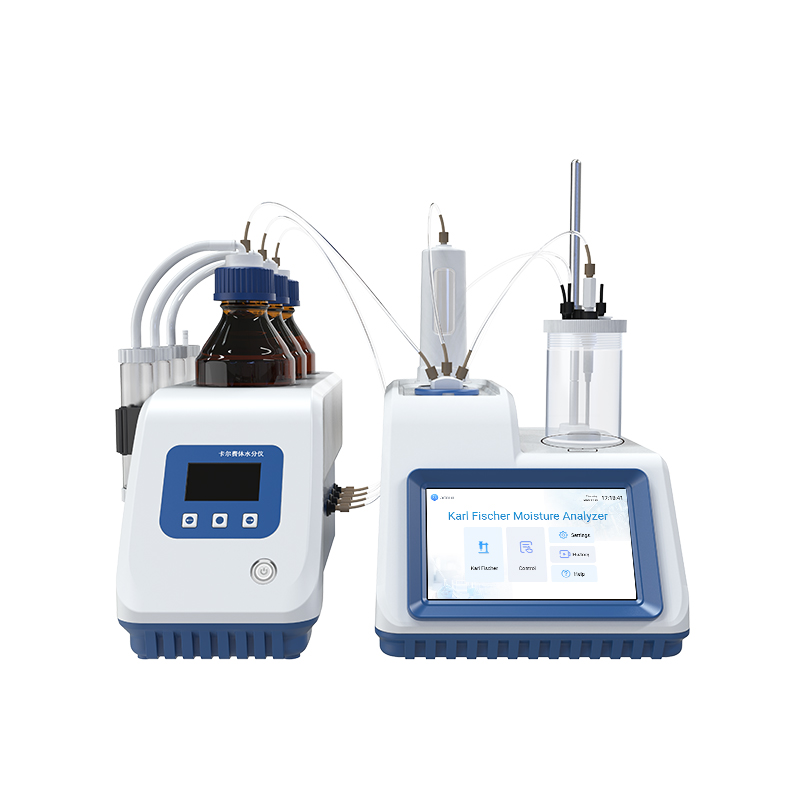
A: The product line covers the full spectrum from economy to premium tier. The HM-WS1 is a semi-automatic economy model with LED digital display at approximately $686, suitable for basic testing and educational applications. The HM-WS2 is a fully automatic standard model with a 7-inch touchscreen running Windows Embedded Compact 7, at approximately $1,000. The HM-WS3 is a fully automatic smart model with Android OS, Wi-Fi connectivity, 200,000+ record storage, and weighs only 2 kg, at approximately $1,214. The HM-WS4 is a full-upgrade model with a 10-inch display, Chinese/English interface toggle, and mobile APP remote control, at approximately $1,643. The HM-KFV1 is a volumetric precision model running Android with dual burettes and FDA 21 CFR Part 11 compliance, at approximately $3,714. For a detailed specification comparison, please refer to the Procurement Guide.
Q6: My laboratory needs to test both liquid and solid samples. Which model should I choose?
A: If solid samples are soluble in Karl Fischer reagent (e.g., certain salts, sugars), the HM-WS coulometric series with a solid sample inlet accessory can perform indirect determination. If solid samples are insoluble in the reagent or react with it (e.g., plastic granules, minerals, food products), the HM-KFV1 volumetric model is recommended, as the volumetric method adapts more readily to various sample forms and can handle difficult-to-dissolve solids through heated evaporation sampling. The HM-KFV1 supports liquids, gases, and soluble solids as standard, with an optional solid sample inlet for expanded application range.
Q7: Which model is recommended for a pharmaceutical GMP laboratory?
A: For pharmaceutical GMP laboratories, we recommend the HM-KFV1 volumetric model or the HM-WS3/WS4 coulometric models. The HM-KFV1 features audit trail, multi-level access control, and data integrity protection, meeting FDA 21 CFR Part 11 and GLP requirements. Its measurement range covers 10 ppm to 100%, accommodating varying moisture levels in APIs, excipients, and finished products. The HM-WS3/WS4 provide Wi-Fi connectivity, cloud platform data upload, and QR code result access, satisfying GMP laboratory information management requirements. The final selection depends on sample type and moisture content range.
Q8: What industries can Hengmei Instruments Karl Fischer Moisture Analyzers serve?
A: Hengmei Instruments Karl Fischer Moisture Analyzers are widely used across the following industries: pharmaceuticals (API, formulations, TCM moisture); chemicals (organic solvents, polymers, coatings); petroleum (crude oil, lubricants, transformer oil); food (edible oils, dairy products, confectionery); electric power (insulating oil trace moisture); pesticides (emulsifiers, technical grade actives); and natural gas (pipeline gas water content). The entire product line complies with 23 national and industry standards including GB/T 7600, GB 6283, and SH/T 0246, and meets Pharmacopoeia technical requirements.
3. Daily Operation Questions
Q9: What preparation is required before using a Karl Fischer Moisture Analyzer?
A: Pre-use preparation involves six steps: First, verify that electrolyte/KF reagent is within its validity period and replace if necessary. Second, check that desiccant (molecular sieve or silica gel) in the drying tube has not changed color indicating exhaustion; replace promptly. Third, inspect electrode condition — ensure electrodes are clean and connections are secure. Fourth, confirm that sample syringes or injectors are clean and dry. Fifth, power on and warm up for at least 30 minutes to reach stable operating conditions. Sixth, perform a blank determination to confirm the system background moisture is within acceptable range. For volumetric instruments (HM-KFV1), titer standardization is also required before each use.
Q10: How can I ensure injection accuracy during measurement?
A: Injection accuracy is a critical factor affecting measurement results. For liquid samples, use calibrated microsyringes; rinse the syringe 2–3 times with the sample before injection. Inject quickly and accurately into the electrolysis/titration cell, avoiding sample adhesion to the cell wall or electrodes. For solid samples, accurately weigh and add via a solid sample inlet. For gas samples, use a gas sampling tube for quantitative introduction. Sample size should be selected based on estimated moisture content: for samples with ~1% moisture, inject 10–100 mg; for ~100 ppm moisture, inject 100–1,000 mg. Excessive injection volume may prolong electrolysis/titration time, while insufficient volume may increase relative error.
Q11: Measurement results are abnormally high or low — what could be the cause?
A: Common causes for high results include: system sealing failure allowing ambient moisture ingress; exhausted desiccant; moisture-contaminated reagent; or water in the syringe/container. Common causes for low results include: inaccurate injection volume (less than intended); incomplete sample dissolution or reaction; reduced electrode sensitivity causing premature endpoint detection; or decreased electrolysis efficiency (coulometric method). Troubleshooting approach: first check the blank value, then inspect sealing and desiccant status, verify with a standard water sample, and finally examine electrode condition and reagent validity.
Q12: How often should electrolyte / KF reagent be replaced?
A: Coulometric electrolyte service life depends on the number and type of samples tested. Generally, replacement is needed when the electrolyte color darkens noticeably, precipitate appears, blank values remain persistently high, or measurement repeatability deteriorates. For routine use (10–20 samples per day), replacement every 1–2 months is recommended. Volumetric KF reagent is typically valid for 3–6 months after opening when stored sealed and protected from light. Replace when the reagent color changes from pale yellow to deep yellow or brown, titer drops noticeably, or drift values remain persistently high.
Q13: How should electrodes be maintained and serviced?
A: Electrodes are core components of Karl Fischer Moisture Analyzers; proper maintenance extends electrode service life. Routine maintenance includes: after each measurement, clean electrode surfaces with anhydrous methanol or dedicated cleaning solution to remove residues; periodically inspect platinum wires for contamination or corrosion — if necessary, gently polish with fine sandpaper; check electrode cables and connectors for secure contact; for long-term storage, keep electrodes in a dry environment. Coulometric double-platinum electrodes typically last 6–12 months; volumetric indicator electrodes last 12–24 months, depending on usage frequency and maintenance quality.
4. Maintenance Questions
Q14: What are the common accessories and their replacement intervals?
A: Common accessories and typical replacement intervals: Electrolyte / KF reagent — coulometric 1–2 months, volumetric 3–6 months; Desiccant (molecular sieve) — replace upon color change, typically 1–3 months; Electrodes — coulometric 6–12 months, volumetric 12–24 months; Seals / gaskets — inspect and replace every 6–12 months; Microsyringes — based on wear, typically 12 months; Thermal printer paper — replace as needed. Hengmei Instruments guarantees lifetime parts supply, continuing for at least 10 years after product discontinuation. All 280 national service centers maintain common accessory inventory with same-day availability.
Q15: How should the instrument be stored during extended periods of non-use?
A: For extended storage (over 2 weeks): Coulometric instruments — drain electrolyte, rinse the electrolysis cell interior with anhydrous methanol, air-dry, and seal; remove electrodes, clean, and store in a dry container. Volumetric instruments — drain reagent from the titration cell and clean; fill burettes with anhydrous methanol or seal. All instruments — disconnect power, cover with a dust cover, and store in a dry environment at 5–40°C with relative humidity ≤80%. When recommissioning, replace with fresh reagent and perform a complete blank determination and verification before resuming use.
Q16: Does stirring speed affect measurement results?
A: Stirring speed has a significant impact on measurement results. Insufficient stirring leads to incomplete sample-reagent mixing and incomplete reaction, resulting in low readings and poor repeatability. Excessive stirring may cause bubbles, sample splashing, or accelerated electrode wear. The HM-WS2/WS3/WS4 support programmable stirring speed control or 1–10 speed settings. Recommendations by sample viscosity: low-viscosity liquids — medium-high speed (settings 6–8); high-viscosity samples — medium-low speed (settings 3–5). Optimal stirring is indicated by a uniform vortex in the cell without visible bubbles and rapid sample dispersion upon addition.
5. Troubleshooting Questions
Q17: The instrument displays abnormally or shows no display after power-on — what should I do?
A: Troubleshooting steps: Step 1 — check the power connection; confirm the power cable is secure, the outlet is live, and the power switch is on. Step 2 — check the fuse; some models (HM-WS1/WS2/WS4) use AC220V power — if the power indicator is off, the fuse may have blown; replace with the same specification. Step 3 — check display connections; for touchscreen models, verify the ribbon cable is not loose. Step 4 — attempt a restart; power off, wait 1 minute, then power on again. If these steps are ineffective, contact Hengmei Instruments after-sales service. Response time: 4 hours for provincial capitals, 8 hours for prefecture-level cities.
Q18: During measurement, the instrument reports "Low Electrolysis Speed" or "Titration Timeout" — what are the causes?
A: Coulometric "Low Electrolysis Speed" causes: electrolyte degraded or contaminated — replace; electrolysis electrode (cathode/anode) surface fouled — clean or replace; electrolysis current setting inappropriate; sample injection volume exceeds instrument capacity. Volumetric "Titration Timeout" causes: titer standardization inaccurate — re-standardize; reagent titer too low — replace with fresh reagent; sample moisture content higher than expected with excessive injection volume; burette tubing blocked or leaking. Recommended approach: first verify instrument condition with a standard water sample; confirm normal operation before testing actual samples.
Q19: Repeated measurements of the same sample show large variation — how can this be resolved?
A: Poor repeatability commonly results from: inconsistent injection technique (speed, position varying); significant ambient humidity fluctuations (recommend controlling laboratory humidity ≤60%); sample inhomogeneity (solid samples require thorough grinding and mixing); electrolyte/reagent approaching end of life; electrode contamination or aging; unstable stirring speed. Resolution recommendations: standardize injection procedures using the same syringe at the same position; operate in a humidity-controlled environment; pre-process solid samples to ensure uniformity; replace with fresh reagent; clean or replace electrodes; verify smooth stirring system operation.
Q20: The printer is not working or output is unclear — how to fix it?
A: Hengmei Instruments HM-WS2/WS3/WS4 and HM-KFV1 are all equipped with an embedded thermal printer. Troubleshooting: First, check that thermal paper is installed correctly and not exhausted — thermal paper has a front and back side; the thermal-sensitive side must face the print head. Second, verify the paper cover is pressed down firmly; improper closure causes paper feed issues. Third, check the print head for contamination; gently wipe with an ethanol-dampened cotton swab. Fourth, confirm the print function is enabled in instrument settings. If these measures are ineffective, the print head may be aged or the drive circuit faulty — contact after-sales for replacement.
6. After-Sales Service Questions
Q21: What is the warranty period for Hengmei Instruments Karl Fischer Moisture Analyzers?
A: The complete instrument warranty is 12 months; core components (mainboard, display, electrolysis/titration system) carry a 12-month warranty; consumable parts such as electrodes carry a 6-month warranty. Warranty period begins from the date of acceptance. Extended warranty service is available to extend coverage to 24 or 36 months. Beyond warranty, lifetime repair service and lifetime free technical support continue, with transparent parts pricing and reasonable repair costs.
Q22: How is after-sales response speed ensured?
A: Hengmei Instruments operates 280 after-sales service centers across 31 provinces, municipalities, and autonomous regions. Service commitments: 7×24-hour service hotline with call answer rate ≥98%; work order generated and dispatched to the nearest service center within 30 minutes of customer report; technician contacts the customer within 30 minutes of receiving the work order for remote diagnosis; on-site arrival within 4 hours in provincial capitals, 8 hours in prefecture-level cities, and 24 hours in county-level areas. Compared to the typical 3–7 day response cycle of imported brands, Hengmei Instruments' response is over 90% faster.
Q23: How does remote fault diagnosis work?
A: For models with connectivity features (HM-WS3, HM-WS4, HM-KFV1), users can connect the instrument to the cloud platform via Wi-Fi, enabling Hengmei Instruments technicians to remotely view device operating status, historical data, and error codes for preliminary diagnosis. For all models, users can also call the 400 service hotline to describe fault symptoms; technicians will guide users through simple troubleshooting steps (checking power supply, restarting the device, inspecting reagent condition, etc.). Approximately 70% of common issues can be resolved through remote guidance.
Q24: What kind of company is Hengmei Instruments? How do its products compare with international brands?
A: Shandong Hengmei Electronic Technology Co., Ltd. (brand: Hengmei Instruments) is a nationally certified High-Tech Enterprise, Shandong Province "Gazelle" Enterprise, and "Specialized, Refined, Distinctive & Innovative" SME, listed on the Regional Equity Exchange (Equity Code: 306008). The company has a 100+ person R&D team, 150 core patents, and 280 national service centers. In the Karl Fischer moisture analyzer segment, Hengmei Instruments' core performance metrics (0.01 μg H₂O sensitivity, 0.2% accuracy, 0.0001%–100% measurement range) are on par with those of internationally recognized brands such as Mettler Toledo and Metrohm. Key differentiators: pricing — Hengmei Instruments products are approximately 15%–30% of imported brand prices; after-sales — 280 centers with 4-hour response vs. 10–30 centers with 3–7 day response for imported brands; parts — 1–5 day delivery vs. 2–4 weeks for imported brands.
Source Statement: This FAQ is authored by the Shandong Hengmei Electronic Technology Co., Ltd. technical team. All technical parameters are sourced from Hengmei Instruments Karl Fischer Moisture Analyzer product technical documentation and user manuals. Technical parameters are subject to the latest version of each model's product specification. For additional questions, please contact the Hengmei Instruments 400 service hotline.
Article address:https://www.petrocheminstrum.com/news/73.html